


The ocean underpins trillions of dollars in economic activity each year. Its natural infrastructure protects coastal cities from storms, sustains fisheries, regulates climate and supports global trade. Yet the ecosystems that make this possible, such as coral reefs, mangroves, seagrass meadows and coastal wetlands, are degrading at an unprecedented pace.
Around the world, restoration initiatives are emerging in response. Projects are replanting mangroves, rebuilding reefs and restoring marine habitats with impressive ecological ambition. The science is advancing and the urgency is clear. But capital is not flowing at the scale and speed required, and the problem is not a lack of projects: it is a lack of structure.
Most ocean restoration initiatives are still generally considered as environmental efforts rather than economic infrastructures and finance-ready assets. As such, investors struggle to assess execution risk, and corporates hesitate when governance and monitoring systems are unclear. Even when impact is real, its economic value is rarely translated into language that financial systems understand.
If the blue economy is to mature, restoration must evolve from narrative-driven funding to structured capital allocation.

This is the purpose of OVAI.
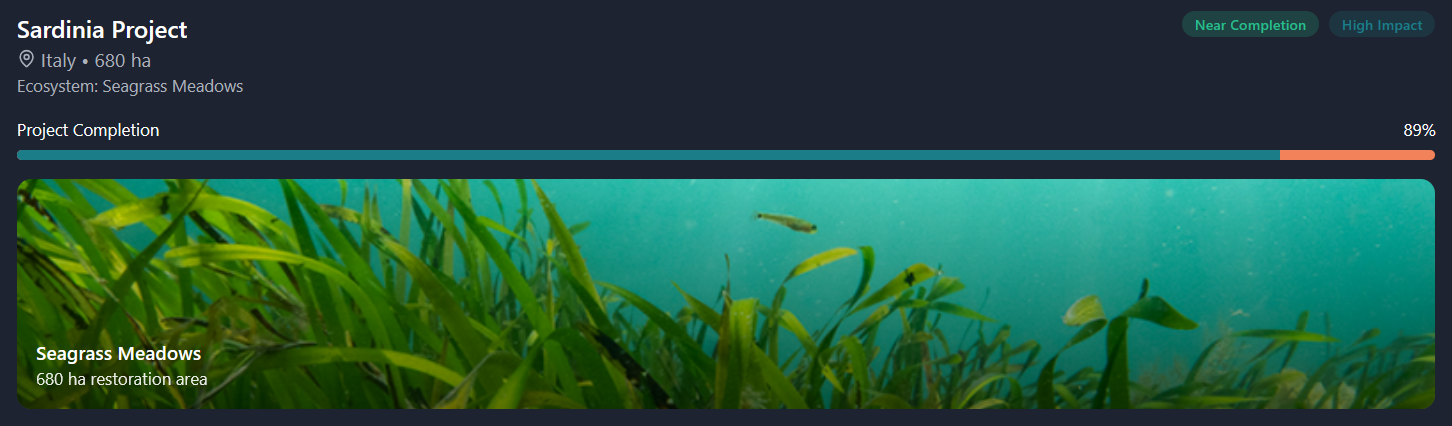
OVAI, inspired by the Tahitian word o’vai (water), stands for Ocean Value Assessment for Investibility. It is the first-of-its-kind tool designed as an integrated financial architecture for marine regeneration. It brings together two essential components that have historically been treated separately: investment readiness and economic valuation.
The first component focuses on readiness. Built on 78 internationally recognized frameworks, OVAI analyzes and map information against its 75 weighted indicators and identify gaps or inconsistencies. Rather than asking whether a project is inspiring, OVAI asks whether it is structurally capable of absorbing significant capital and delivering measurable outcomes over time. This reduces uncertainty before money is deployed and provides developers with a clear pathway to strengthen their foundations.
The second component addresses value. Built on internationally recognized ecosystem accounting principles such as the SEEA-EA, OVAI quantifies both the physical condition of restored ecosystems and the economic value generated by their services. It measures habitat extent and ecological condition, identifies ecosystem services such as coastal protection or fisheries productivity, and estimates the associated economic benefits and avoided costs using established methodologies. Over time, it tracks changes in ecosystem asset stocks, allowing value evolution to be monitored rather than assumed.
By combining these two dimensions within a single framework, OVAI reframes restoration as natural capital development.
How OVAI Uses Artificial Intelligence
OVAI integrates artificial intelligence to enhance accuracy, efficiency and scalability across the assessment process.
When project data and documentation are uploaded, AI models assist in analyzing qualitative and quantitative inputs, identifying data gaps, flagging inconsistencies and mapping information against the framework’s 75 weighted indicators. This accelerates due diligence while preserving methodological rigor.
On the valuation side, AI supports the modeling of ecosystem service proxies and scenario simulations. It enables users to explore different investment levels, time horizons and ecosystem performance trajectories. By automating complex data aggregation and scenario comparisons, OVAI makes ecosystem accounting more accessible without oversimplifying it.
Importantly, AI does not replace expert oversight. Results generated through the platform are subject to methodological validation and human review to ensure credibility and consistency. The objective is not automation for its own sake, but intelligent augmentation to reduce friction in biodiversity finance while maintaining integrity.
A Starting Point
Moshun.Earth does not claim that ecosystems can be reduced to simple price tags. Nor does it suggest that valuation replaces conservation ethics. Instead, it recognizes a practical reality: financial systems allocate capital based on structured information about risk and value. Without that structure, restoration remains peripheral.
For corporations, OVAI enables more credible engagement with marine projects by providing robust due diligence and quantifiable ecosystem value.
For investors and asset managers, it allows comparison across projects and aggregation at portfolio level, turning biodiversity exposure into a measurable and assessable risk–return factor.
For project developers, it offers a roadmap to transition from grant dependency to scalable, investment-ready financing, underpinned by strengthened governance, robust monitoring frameworks, and demonstrable economic value creation.
Importantly, OVAI is not a finished solution but a starting point, designed to evolve through iteration, validation, and market integration. It acknowledges that markets scale when three conditions are met: risks can be understood, value can be measured and performance can be tracked over time. Historically, ocean restoration has struggled to meet these conditions simultaneously. OVAI brings them together.
Finally, turning ocean restoration into real assets does not mean commodifying nature, but rather recognizing that ecosystems generate tangible value and deserve disciplined capital allocation. It will help move from symbolic commitments to structured regeneration so it can scale on clarity, credibility and financial architecture.
Your Investibility Score Awaits
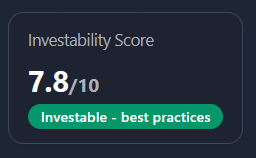
Join the OVAI waitlist to receive priority invites, insights, and first looks at high-integrity projects.
Limited spots available.

Want to
know more?


